Monday, November 5, 2012

Developing a Developer


Hello readers.

In this post I'm going to announce something special. I want to make a little game. It's going to be a small thing, but it's because I promised a friend to make one, and I have to fulfil my promises. It's also the perfect excuse to catch up with this beautiful hobby.

This is mainly a training project. I'll write posts in a journal entry style. That way you can track my progress.

I've divided this project in four phases:
1) The Basis
2) The Tools
3) The Experiments
4) The Games

PHASE 1: The Basis

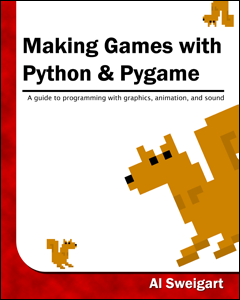
I'll try to restore the knowledge about game programming I had in the past. It's basically reading this book:


“Invent Your Own Computer Games with Python ” is a free ebook. It's oriented to children that want to make computer games but don't know how to program. When I finished my first programming course (it lasted a year) I realized that I knew many algorithmic things. I knew how to search items in lists, storing integer in arrays, import libraries... It was a very good improvement taking into account that I started without knowing anything about programming. Nevertheless, I didn't know how to do something actually useful. And games... well, it's sort of what we all think of, don't we? So that summer, I found this book and read it. After that I made two simple games, but they were lost one sad day when I accidentally erased all the information in my hard-drive.

PHASE 2: The Tool

It's learning more about game programming but it will be mainly using the Pygame library. Actually, this phase is yet another excuse to read the sequel of the previous book: 


I have no idea what it's going to contribute to my knowledge, but I had so much fun reading the first one that I have to read it now.

PHASE 3: The Experiments

This phase it's probably going to be a little bit more chaotic. I'll make a kickoff game that doesn't take a lot of time. Let's see how it goes. I'll also read a few open source programs to take knew ideas. I also may do this kind of things after reading the first book.

PHASE 4: The Game

I'll program the game. I have no idea how long this phase is going to take me. Maybe two weeks? Three? A month and a half? I have an idea about how it's going to be, but I have no idea how I'm going to be posting about it without spoiling the argument. We'll see.


Monday, October 29, 2012

Setting up a Gmail account in Mozilla Thunderbird

I write this post in order to share my experience with my Gmail account in Thunderbird.

The first problem I faced involved contacts. When I wrote my first message, I didn't enjoy the comfort of predictive contact suggestion (because I hadn't any contacts stored on my local machine). I solved it through a plugin: Zindus. Zindus syncronizes your contacts between Thunderbird and Google Contacts. Its use is pretty straightforward. Once you've installed the plugin, you go to the “tools” menu and select “Zindus”. Then add your gmail account, select the convenient options and click on “Sync Now” before you finish. VoilĂ . Contacts loaded, suggestions enabled.

The second thing I missed was the conversation thread-style that Gmail provides. I installed another plugin again: ThreadVis. It works like a charm. In fact, it has a fun feature that Gmail doesn't have: a timeline of the conversation. The following picture is an example of what I'm talking about:


In the picture, the empty circles represent my messages. The filled ones refer to other participants in the conversation (one color per participant). The separation between each circle represents the time it has passed between each message.

I also changed the relative position of the reply to the quote. The settings by default put the reply bellow the quote. This is not the way Gmail behaves and I found it a little bit confusing and counterintuitive. In order to change this go to “Edit > Account Settings... > Compositing and Addressing”. On the window you shoud see a checkbox that says “Automatically quote the original message when replying”. Check it if it isn't. Below that checkbox, you can select the following option from the drop-down list: “start my reply above the quote” and, if you use a signature, you can also select where to place it. It works, but you have to place an enter between the reply and the quote, otherwise Gmail won't hide the quote.

Finally, I set up my Google Talk account. Everything works fine. However, there are a few things that I haven't been able to fix and that I miss:
  • Sync Gmail labels with Thunderbird. Maybe there's a way, but I haven't been able to do so. Here, people say it's impossible:
    http://superuser.com/questions/48591/how-do-i-synchronize-thunderbird-tags-with-gmail-labels
    Nevertheless, the message is old. Perhaps, this issue might be already solvable with a plugin.
  • An Android icon next to the contacts in Google Talk. Actually, Thunderbird provides you information about the devices your contact is connected to. If you put the mouse pointer on the contact, Thunderbird retrieves this information. Nevertheless, I'd rather prefer the icon. I find useful to know if my contacts are chatting from an Android device, because that way I know I'll probably have to wait more for replies, links are going to be visualized on a phone and that sort of things.
  • I have to delete conversations message by message. Gmail allows you to remove an entire conversation easily. The good news is that deleting messages is synchronized between Gmail and Thunderbird.
Feel free to post a comment if you've found this post useful or have any suggestions to solve any of the problems I still experience.

Wednesday, October 3, 2012

Making Magic Number Cards


The following video has inspired me to write this post:


I've automatized the number card generation.
Screen shot for “2 to the power of n” option:
10-3-2012_1

Screen shot for “Fibonacci” option:
10-3-2012_2

Screen shot for “primes” option:
10-3-2012_3

You can download the Python scripts by clicking here. (They're compressed in a zip folder).

Monday, August 20, 2012

The Hunger Games... Probabilities?


SPOILER ALERT. If you've not read The Hunger Games by Suzanne Collins or you haven't managed to get through the first two paragraphs of chapter 2, this post might spoil some important plot twists you might want to read yourself.

I'm reading The Hunger Games by Suzanne Collins. Although I've read only half of it, I'm enjoying it. However, I can't help it. I need to post about it... with the usual probabilistic approach. I'm going to write about the odds of being elected as a tribute in the day of the reaping in District 12. The trigger? The following fragment in chapter 2:

There must have been some mistake. This can’t be happening. Prim was one slip of paper in thousands! Her chances of being chosen so remote that I’d not even bothered to worry about her.

INTRODUCTION


Just as a reminder, lets see what the rules are:
    • Each member of any district between 12 and 18 (both included) participate in the game.
    • Every year, the participants have an entry for the game.
    • Entries are cumulative. So, your name is in the pool once at 12, twice at 13, three times at 14, …, and seven times at 18.
    • You can add more entries (cumulative, remember) in exchange for tesserae: "Each tessera is worth a meager year’s supply of grain and oil for one person". It is convenient for people who are starving because they get food, and for rich people because it gives them statistical coverage. For example: Gale, being 18, participates with 42 entries, for every year he's traded 5 additional entries for tesserae in order to sustain his family.

ESTIMATING DISTRICT 12 DATA


The book doesn't provide the actual number of people living in the district. It doesn't provide the entries signed for the reaping day either. It just says that the population of District 12 is about 8000. Knowing that District 12 is quite a poor place, I've decided to transform the population distribution of a poor country to simulate District 12's population pyramid. I've chosen Burundi for it's poverty levels (no evil purpose, neither any other similitude with District 12).

This is Burundi's 2005 population pyramid for male population (according to Wikipedia).


Not having the exact data shown in the pyramid, we have to extract it manually. I've measured the length of the bars of each age group using the Measure Tool in Gimp. I approximate the result using only 2 decimal digits. I've measured only the left side of the pyramid and I assume it is perfectly symmetric. The extracted data for one sex is found in the following table.
 
Age
Population
[0, 4]
0.72 millions
[5, 9]
0.6 millions
[10, 14]
0.51 millions
[15, 19]
0.44 millions
[20, 24]
0.37 millions
[25, 29]
0.29 millions
[30, 34]
0.23 millions
[35, 39]
0.19 millions
[40, 44]
0.15 millions
[45, 49]
0.13 millions
[50, 54]
0.1 millions
[55, 59]
0.07 millions
[60, 64]
0.05 millions
[65, 69]
0.04 millions
[70, 74]
0.03 millions
[75, 79]
0.01 millions
80+
0.01 millions


The total population for one sex: 3.94 millions.


Now, I assume that the population pyramid of District 12 is also symmetric (i.e. 4000 for one sex). The transformed table would be like this.

Age
Population
[0, 4]
731
[5, 9]
609
[10, 14]
518
[15, 19]
447
[20, 24]
376
[25, 29]
294
[30, 34]
233
[35, 39]
193
[40, 44]
152
[45, 49]
132
[50, 54]
102
[55, 59]
71
[60, 64]
51
[65, 69]
41
[70, 74]
30
[75, 79]
10
80+
10

I need to get the specific population for 12 year old, 13 year old, …, and 18 year old people. In order to do that, I'll express the previous table with it's accumulated values.

Age
Population
[0, 4]
731
[0, 9]
1340
[0, 14]
1858
[0, 19]
2305
[0, 24]
2681
[0, 29]
2975
[0, 34]
3208
[0, 39]
3401
[0, 44]
3553
[0, 49]
3685
[0, 54]
3787
[0, 59]
3858
[0, 64]
3909
[0, 69]
3950
[0, 74]
3980
[0, 79]
3990
TOTAL
4000


And now, I need a function that describes this behaviour. If I had such a function, I would be able to extract the values for a single age. We know the following points of the function:

[0, 0], [5, 731], [10, 1340], [15, 1858], [20, 2305], [25, 2681], [30, 2975], [35, 3208], [40, 3401], [45, 3553], [50, 3685], [55, 3787], [60, 3858], [65, 3909], [70, 3950], [75, 3980], [80, 3990], [83, 4000]

As you can see, I've forced the last point a little bit (the oldest person is 83 years old). I don't think there are so many old people in District 12.

So, I need to interpolate. I'm going to use the implementation of Lagrange Interpolation I've found in this web page. However, since the web page itself doesn't allow me to use all the points, I'm going to use only up to x=30 (included) so the function will be more manageable. The result is:

f(x) = (3x⁶-270x⁵+7250x⁴-5000x³-5320625x²+300106250x)/1875000

In order to extract the ages of interest, I've made a Python script. You can download it by pressing here. The results I've obtained are the following:


661 kids participate in the day of the reaping.

Mmmm... I bet there's only one school in District 12... It makes sense, the mayor's daughter and Katniss went to the same school... But let's keep focused!


PARTICIPANTS AND ENTRIES


Each year every participant makes a new entry. You can find another Python script to calculate the mandatory entries. Screen capture with the results:


2566 entries! That counts as one in thousands... Either Katniss was exactly right or she was pessimistic (with pessimistic I mean the probabilities were actually lower, don't forget there are people that put more entries in exchange for tesserae).


TESSERAE


Taking tesserae into account might be a bit tricky... Nevertheless, this is my approach.

Returning to Burundi's case, Wikipedia states that 80% of the population lives in poverty. I'll extrapolate it to District 12. So, those 80% would need tesserae. However, it's not told in the book, but it suggests that usually the older brothers who can participate in the Hunger Games are the ones who asks for tesserae for the rest of the family in order to prevent the young ones of having higher probabilities of being elected (Katniss and Prim both live in poverty, but Katniss risks in exchange for both Katniss and Prim's tesserae, instead of distributing the risk). So, I'll say that only 60% are going to ask for more tesserae. I'm going to consider Gale's case extreme. This is what I think it could be a reliable distribution:

  • 40% asks for no tesserae.
  • 25% asks for one tessera.
  • 15% asks for two tesserae.
  • 10% asks for three tesserae. (Katniss belongs to this group).
  • 7% asks for four tesserae.
  • 3% asks for five tesserae. (Gale belongs to this group).

That being said, the entries are corrected (another Python script) and the new results are:


Katniss was right! Incredible! I envy her math skills! Nevertheless, probabilities speak about the uncertain. Therefore, until we know the results, anything can happen! Prim could have been elected as well as Katniss, for her probabilities are higher than 0. I bet the author put the words in Katniss' mouth just to reflect the adolescent indignation with the world, which in my opinion it's very well portrayed in the book. Beating around the bush again, sorry.


PROBABILITY OF BEING ELECTED IN A LIFETIME


I'm going to do one final calculation: the probabilities of Prim being elected at some point in her life. The result will be the same for any kid who doesn't ask for any tesserae. For this, I assume the number of participants remains constant in time (i.e. each year there are exactly 661 participants and 5664 entries). I don't know if this assumption is correct, because I don't know the birth rate, and the mortality rate of District 12 (poverty could also vary from year to year); but I'll assume the age distribution remains constant in time.

The probability is:

1 – [(1–(1/5664)) x (1–(2/5664)) x (1–(3/5664)) x (1–(4/5664)) x (1–(5/5664)) x (1–(6/5664)) x (1–(7/5664))] = 0.004933476478782839

0.4933% is the probability of being elected as a tribute if you don't ask for more tesserae.

I hope you enjoyed this post. It's a little bit longer than usual...

Friday, August 3, 2012

The maths of the EuroMillions

My uncle is very engaged in this game, and I've found a little inspiration to write about it. Lottery... I hate it. However, lets see what science has to say about this.

The player must choose 5 numbers between 1 and 50 and 2 stars (stars are numbers as well) between 1 and 11. Numbers cannot be repeated.

Let's see how many combinations of 5 numbers and 2 stars can we make:

We can choose 5 numbers in 50*49*48*47*46 = 254251200 different ways, but the order doesn't matter. There are 5! = 120 ways of ordering 5 numbers, so there are 254251200/120 = 2118760 ways of selecting the numbers without taking into account the order of selection.

We can choose 2 stars in 11*10 = 110 different ways, but (again) the order doesn't matter. There are 2! = 2 says of ordering 2 stars (which are also numbers), so there are 110/2 = 55 ways of selecting the numbers without taking into account the order of selection.

Combining those numbers and stars, there are a total of 116531800 ways of betting in EuroMillions.

Taking this as a starting point, I've made a simple program (a script written in Python) that outputs the following:

08-03-2012_1

If I've made it correctly, as the output says you need to play 80773689 times in a row to make your chances higher than 50%. In Spain, each ticket costs 2€, which means that if you want to avoid losses, you should only play when the jackpot is 161547378€ or higher (162 million in easy terms).

Notes:
- Actually, chances of winning are higher, since there are other prices, perhaps I should do the maths in another post, but here you can get a general idea.
- When I say that you should play for those jackpots, chance is still very little and you should buy quite a lot of tickets. You may need several million years to make profit playing lottery.
- Every lottery company expects to make money, so it's not a surprise if you end up with losses.
- Some people play because when they buy a ticket, they're buying a dream.
- Maths know nothing about dreams, just numbers.

Friday, July 20, 2012

What is randomness?


This post is rather a philosophical opinion than anything else. It's going to be a little bit provocative, so if you don't agree with anything, feel free to comment and share your thoughts about it.

Randomness doesn't exist in a strict way. Randomness is only a way to model problems. There's only cause and effect. Let's look at some examples:

When we cast dice, we say the result is going to be random. Using the classic rule of probability, we would say that we have a probability of 1/6 (16.6667%) of getting a specific result when casting a single die. We've model the problem using probabilities and measuring the uncertainty of getting a specific result.

But remember, that's only a model, a tool that represents the problem and gives us solutions (in this case the solutions are in form of probabilities). But what is actually happening isn't random. Let's simplify the problem.

If I put the die with the 3 face up, and only raise it half a millimetre from the floor, when I release the die I will get a 3 for sure!

That's cheating – you may think. And if we're playing risk or backgammon... you're right, I would be cheating. It's cheating because the experiment of casting a die here is quite controlled. I want to get a 3 and I've set the conditions of the experiment to favour my intention.

Well, the experiment isn't quite different if I cast the die at 1 metre from the floor. The only difference here is that I no longer control the experiment and it seems random. So, probabilities here are a good model for the problem, but they doesn't exist for real. Let's assume that I have a supercomputer that is able to take all the variables into account. They could be: initial height, die and floor surface irregularities, floor elasticity, die elasticity, Coriolis effect, wind speed and direction, rotation given by the hand (taking into account that it might be slightly shaking)... Actually I don't even know all the variables of the problem, and I don't think there exists such a computer, but let's assume. If the computer existed and the variables were known the problem can be solved and I would predict the result of the die perfectly.

The same happens when generating a pseudorandom number in a computer. It uses a deterministic algorithm. It might use a “random” seed, but if we know the seed, we know the result. Sometimes the seed it's taking by the time of the clock in milliseconds, but again if we know exactly when this happens, we predict the result.

When we shuffle a deck of cards its the same. If we were able to keep an eye while shuffling, we would know the order of cards in the deck perfectly.

However, we don't know all the variables of all these problems. That's why there seems to be a random entity. So, the probability of an event X occurring, it's just a measure of our ignorance. The higher the chances, the more certain we are that X is going to happen. When we add knowledge to the system, probability changes. This happens for example in the Monty Hall problem. Here you can see a scene of the film 21 in which the problem is discussed:


Final thought. I think that science is about acquiring knowledge of the universe. It's about identifying the cause that produces the observed effect. In the Renaissance, a physician would observe a group of sick people. He would see that all of them had drunk from the same water. Finally, he would conclude that that water is different from normal water. Doing some research he would find a virus in the water. He would then think: “if I kill the virus, health will return”. And using cause an effect he would pull science forward while healing his patients.

Nowadays, so called scientists often say: “the universe exists because of chance”, and what is worse, they get satisfied with their own answer. Whenever we speak of chance there's still knowledge to be unlocked. If you talk in terms of chances, it means that you've model the problem, but you don't fully understand the nature of if. And being satisfied with the answer means that you're comfortable being ignorant about something which definitely is not a trait of the western scientific tradition.

SUMMARY: I'm not saying that randomness is completely useless. In fact, I use it constantly! I love chance games and I love to calculate probabilities and get the best strategy. Randomness is useful because it provides us a way to manage the lack of knowledge. I accept not knowing the result of the die while playing risk, but I don't accept not knowing more important things about the universe and simplify everything with the sentence: “it's all chance”.